- Pictures
- Damage Patterns
- Biology
- Propagation
- Pest Control
- Biological Control
- Historicals
Mealybugs (sometimes called 'Wooly Aphids') suck the cells dry and secrete honeydew. The high level of contamination with honeydew and subsequent colonisation with sooty moulds (sooty mould) causes enormous damage to the plant. If mealybugs are not treated properly immediately, they will appear in large numbers, resulting in leaf deformation and severe growth inhibition. Sucking sites on individual animals are surrounded by yellow to reddish spots. Mealybugs usually sit under the leaves; young infestations on flowering plants are always found on the flower stems at the transition to the flowers.
The family of scale insects comprises around 1,000 species, which differ in terms of the length of their tail filaments and the type of hairiness, among other things. They reach a body length of between one and twelve millimetres. However, members of this family do not have a cap-like shield; adult animals are powdered with a mealy wax secretion. The edges of their bodies are covered with spines, and some have very long wax filaments, especially at the rear end.
Two species are significant in Central Europe.
The citrus mealybug (Planococcus citri Risso): It grows to a length of 3.0-5.0 mm, is oval in shape and dark yellow to yellowish brown in colour, powdered with wax secretions, and has short, thick filaments on the edge of its body. It is highly polyphagous and produces large amounts of honeydew. The yellow eggs are laid in woolly masses on the abdomen, with an optimum temperature of 24°C.
Long-spined mealybug (Pseudococcus longispinus Targ.-Tozz. [= Pseudococcus adonidum L.]): 3.0-5.0 mm long, reddish to orange-coloured, oval mealybug. Characteristic is the length of the tail filaments, which are about as long as the body of the insects. Extremely heavy honeydew excretion is noticeable.
Mealybugs originate from tropical regions worldwide and have established themselves as the main pest of the Phalaenopsis genus in recent years. The waxy excretions help the species to survive temperatures as low as minus 40°C.
Reproduction usually occurs via eggs, but some species are predominantly viviparous under favourable conditions. Most species lay their eggs in a protective (hairy) wax coating. Egg laying usually takes place during the warmer months, with hundreds of eggs being laid. This results in one to two generations per year, or up to eight generations under very favourable conditions, such as in a greenhouse. In contrast to armoured scale insects, most mealybug species prefer herbaceous plants.
Achieving reasonable and lasting success in combating mealybugs is a long-term endeavour:
- The first step in preventing infestation is to carefully inspect imported material. Look for mealybugs in leaf axils and shoot tips. Pests that have been introduced unnoticed can often remain hidden for several months until visible damage to the crops occurs. As long as the infestation is limited to a few plants, these should be destroyed. However, as soon as symptoms appear in several places or an initially invisible infestation develops into a problem, chemical measures are unavoidable.
- The best time to use chemical control is during the hatching of the young insects. Insecticides are most effective at this stage. Mealybugs can be controlled relatively easily as long as no wax coating has formed. However, as all stages are always present on the plants at the same time, meaning that young insects are constantly emerging, and as the larvae take a very long time to develop, repeated treatments must be carried out at intervals of 10-14 days.
- Chemical control should always be carried out in the evening, and the plants should be well watered. The optimum temperature is 16-20°C, depending on the spray. The spray mist should be very fine; you can add 1-2 drops of washing-up liquid to break the surface tension of the water.
- Depending on weather conditions, the treatment must be repeated 2-3 times at intervals of 3-6 days.
Parasitic wasps are very effective in controlling mealybugs:
Leptomastix dactylopii :
A small, 3 mm parasitic wasp, very effective against Planococcus citri. The insect is yellow-brown in colour and makes short, hopping jumps. High temperatures of at least 24-27 °C are necessary for optimal development. Eggs are then laid in sufficient numbers in the third nymph stage and in adult mealybugs. High light intensities are required, and use in summer is recommended. Pseudococcus is not parasitised by the parasitic wasp.
Leptomastidea abnormis :
Yellow-brown in colour, only about 2 mm long. Only Planococcus citri is parasitised. Temperatures of 20-24 °C are ideal for the development of the parasitic wasp. As the insect has low light requirements, it can also be used in spring and autumn.
Cryptolaemus montrouzieri :
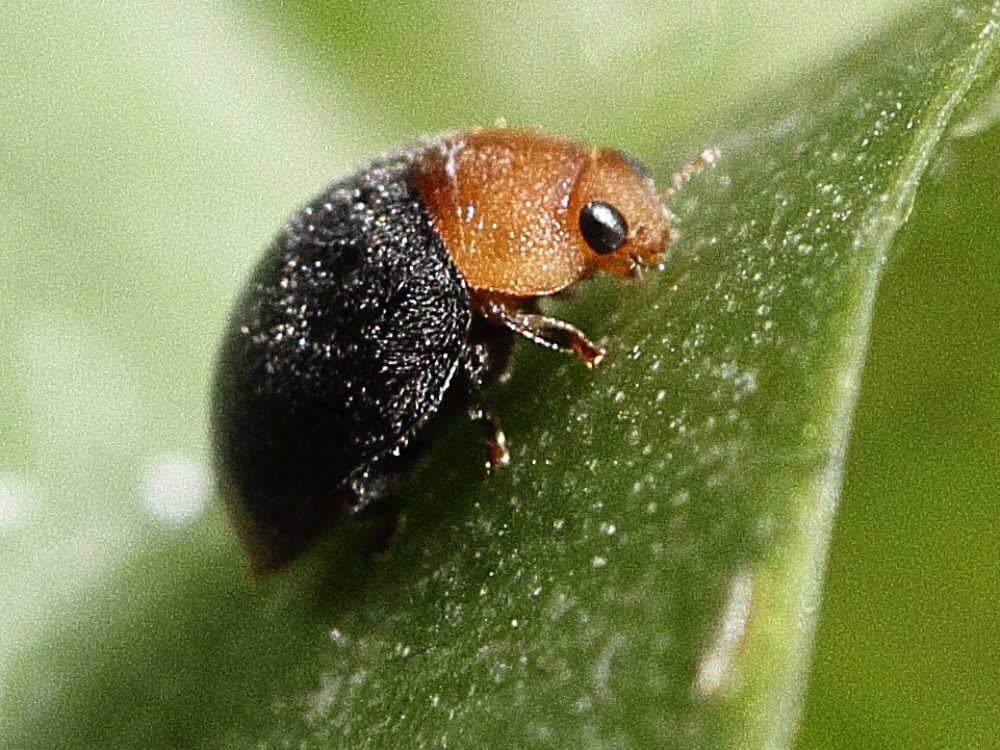
The Australian ladybird is 4 mm in size, orange in colour with black wing covers. The larvae are approximately 13 mm long and covered in white, waxy powder. Cryptolaemus is a predator that feeds on all known species of mealybugs. Its suitability for infested areas also makes this beneficial insect an interesting option. The beetle does not usually complete its entire development cycle in the greenhouse. It is also only effective against Planococcus citri.
Time and again, tips can be found on the internet and in some "specialist magazines" advising people to search for the insects. We strongly advise against this, as you will only catch the large insects and smear the eggs on the plant or cause them to fall into the substrate. Three weeks later, the number of visitors to the burial site will be enormous.
In cases of very minor infestation, the insects can be dabbed with alcohol (which destroys the web) and neem or cooking oil. The oil can suffocate the insects. This method is very environmentally friendly, but takes a lot of time.
Wool and mealybugs only appeared in European crops at the end of the 20th century, more or less at the same time as the mass distribution of Phalaenopsis, their favourite food.