- Bilder
- Damage Patterns
- Biology
- Propagation
- Bekämpfung
- Biological Control
- Historicals
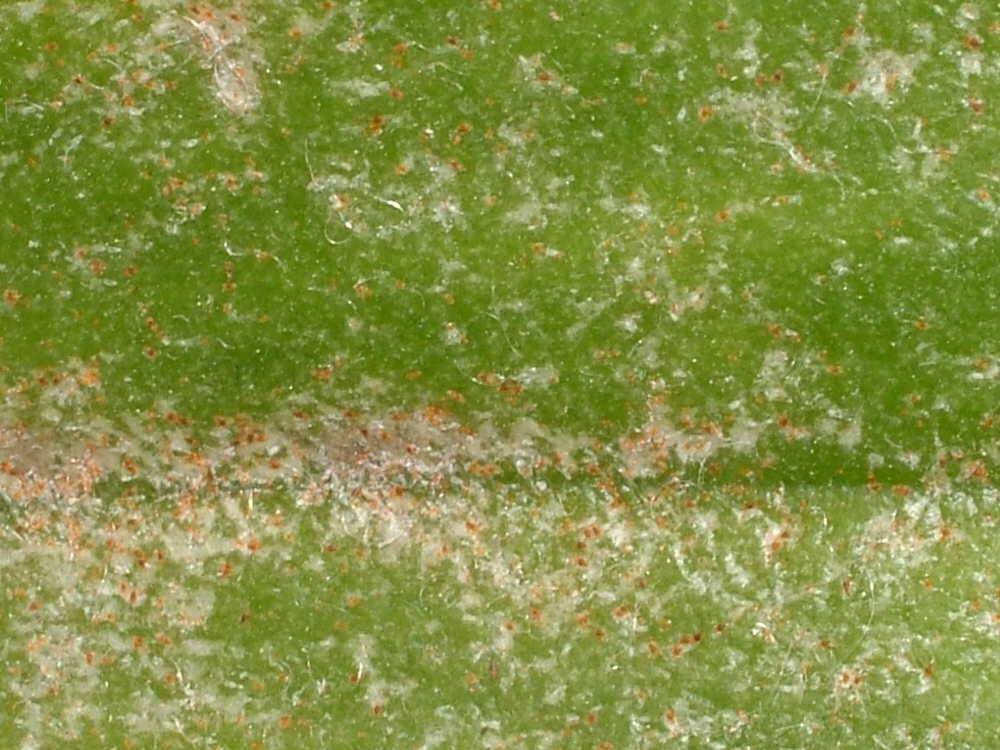
Spider mites or red spiders suck individual cells dry, allowing air to penetrate. The leaves therefore initially appear silvery in places, often with whitish speckles. As the infestation worsens, the spots merge, the leaves turn pale yellow and eventually dry out. Fine, light-coloured webs can later be found on the undersides of the leaves, and eggs and moulted skins can be seen with a strong magnifying glass.
The approximately 1,200 known species of spider mites are found all over the world. Many species are plant-specific, while others attack everything. In Europe, the "red spider mite" (Tetranychus urticae Koch) is widespread as a crop pest. The name comes from the red colouring of the winter females, but the colour spectrum of the animals can also include yellow and green.
Spider mites have separate sexes (male and female), with females often larger (0.4–0.6 mm) and bright red-orange in colour during winter, while males are smaller (0.3–0.45 mm) and appear more yellow-greenish during the season, with dark spots on their backs. Reproduction is complex: males help females moult so that they can mate quickly, often resulting in several generations per year. Females can lay up to 20 eggs. The development period from egg to six-legged larval stage to eight-legged adult is highly dependent on temperature and humidity and takes 10 to 20 days. In dry and warm air, 8–10 cycles per year are possible.
Pest Control
Chemical control is very difficult, as there are hardly any approved treatments left. In addition, red spider mites quickly develop resistance, and many sprays are only effective at certain stages of development.
Red spider mites thrive in temperatures above 24°C, humidity below 60% and draughts. These factors should be eliminated first. Biological control is possible with predatory mites of the species Phytoseiulus persimilis Athias-Henriot. The adult mites suck out the eggs and larvae of the spider mites. At temperatures between 17°C and 25°C and a relative humidity of 75%, the predatory mites have ideal breeding conditions and develop better than spider mites.
These treatment methods from 1848 are provided for informational and entertainment purposes only. Please note that the use of some of the chemicals mentioned here is no longer permitted today, as they can be harmful to health (including that of the user) and very harmful to the environment. Reading, reflecting and smiling are permitted, but do not attempt to replicate these methods.