- Pictures
- Damage Patterns
- Biology
- Propagation
- Pest Control
- Biological Control
- Historicals
Woodlice feed primarily on old substrate particles: they break down organic material and enrich the soil with nutrients, making them 'decomposers'. They eat dead plants, wilted vegetables and fruit, but also fungi. Only when the infestation pressure becomes too high (food supply lower than demand) do they eat fresh plant parts; soft, fresh, young leaves, root tips, but also fresh flower shoots are among their preferred foods. Their feeding activity can also destroy the aerobic structure of the substrate, which can lead to rot in the long term. Similarly, the "composting" of the substrate can lead to an increased or excessive supply of nutrients.
The feeding traces resemble those of snail infestation, but without the slime trails.
Isopods (Woodlice are terrestrial isopods) belong to the crustacean family and originally come from the sea. Around 3,700 species of woodlice are known worldwide, around 50 of which are found in Germany. Woodlice have seven pairs of legs and a consistent number of body segments. Their gills are located on their rear legs. However, different species show varying degrees of adaptation to life on land, so in addition to gill respiration, there are also species with other respiratory organs such as tracheae or lungs.
Even though most land woodlice have developed tracheal organs (open respiratory system like insects), they still use the gills located on their hind legs. Therefore, woodlice need moist hiding places; prolonged exposure to dry conditions would cause their gills to die.
The most common species are:
woodlice (Armadillidium sp.)
cellar woodlice (Porcellio scaber Latr.)
mason woodlice (Oniscus asellus L.).
Woodlice are dioecious, meaning there are males and females. Depending on the species, the animals reach sexual maturity between the first and third year of life. Mating takes place without mating rituals, usually only once a year. After mating, the females moult and develop a brood chamber between their walking legs, known as a marsupium. Between 10 and 70 eggs (or more, depending on the species) are laid in this brood chamber, where they mature protected by the body's own fluid, like in a "portable aquarium". After 40 to 50 days, the young hatch and must survive on their own. The female's shell, which is still very thin at this point, is replaced after the eggs hatch in a double moult and then hardens.
Hygiene and no damp hiding places are the basis for combating them. Chemically, the same agents that are used to combat snails can be used.
Since woodlice are more likely to be found in a greenhouse than in a flat, damp hiding places should be completely dried out. Repotting at the right time of year into fresh, structurally stable substrates is also important. The use of nematodes only helps to combat newly hatched young animals. Adult animals are not harmed.
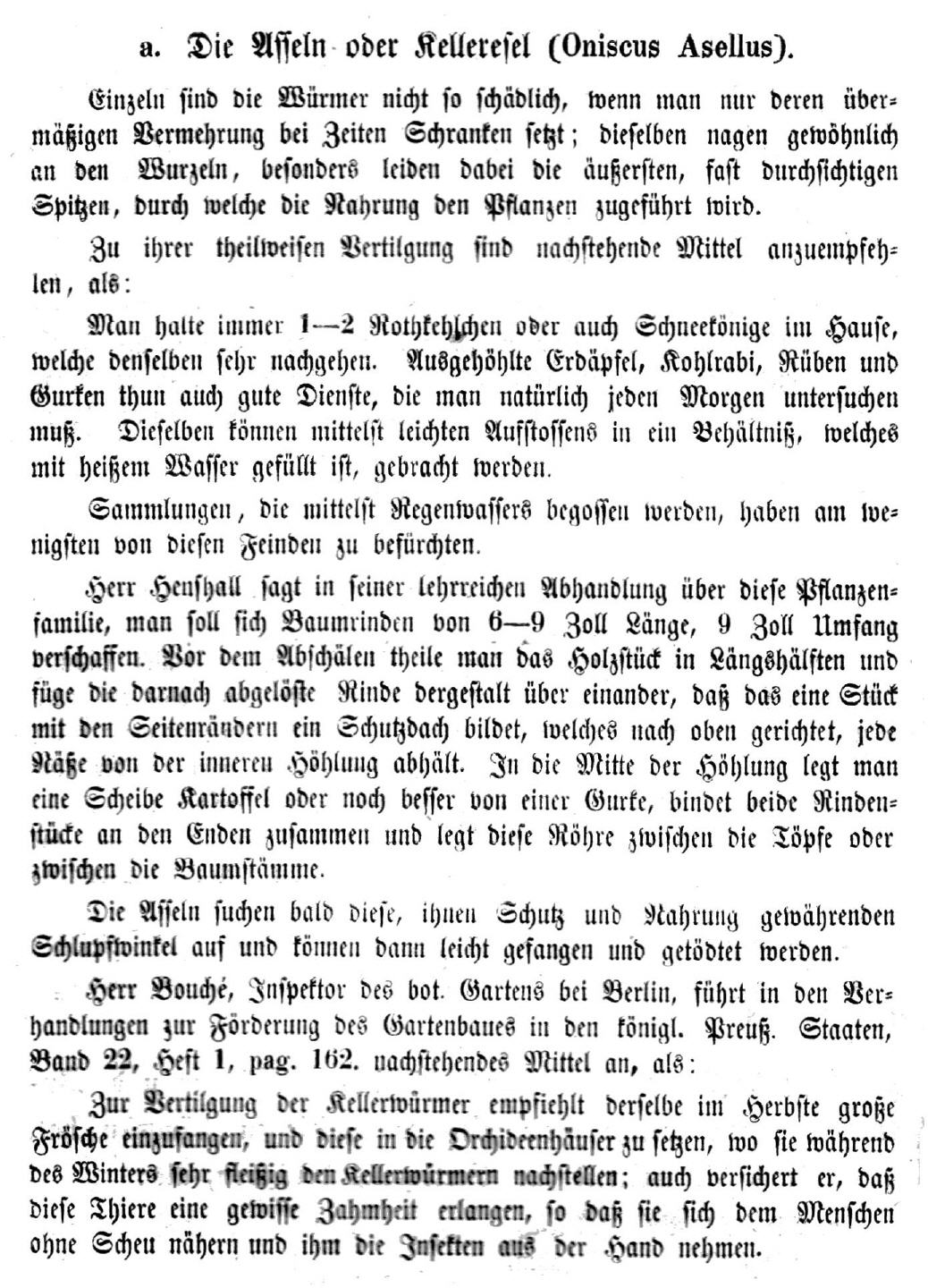
These treatment methods from 1848 are provided for information and entertainment purposes only. Please note that the use of some of the chemicals mentioned here is no longer permitted today, as they can be harmful to health (including that of the user) and very harmful to the environment. Reading, reflecting and smiling are permitted, but do not attempt to replicate these methods.